
EPBD 2024 Is Coming to National Law — Are You Ready?
Stricter energy efficiency requirements for non-residential buildings are no longer a distant prospect. Deadlines are here.
Quick Answer
Driven by the European Green Deal, the revised EPBD introduces stricter requirements for non-residential buildings to improve energy performance across Europe. Member States must implement these rules by May 2026. Since heating, cooling, and ventilation drive two-thirds of sector-related CO2 emissions, the directive significantly increases renovation obligations — making compliance urgent, not optional.
Key Takeaways
- The revised EPBD 2024 is the most stringent building energy directive in European history.
- All EU Member States must transpose the directive into national law by May 29, 2026.
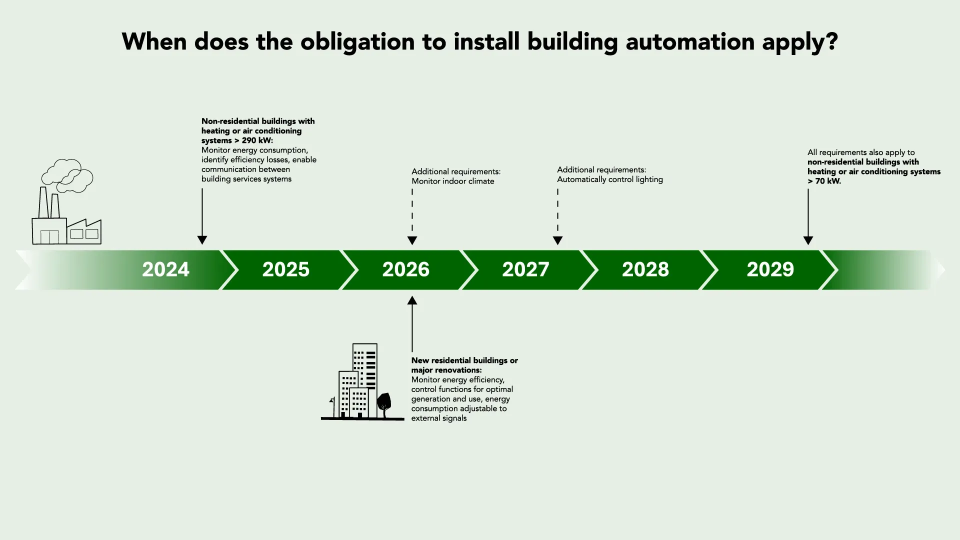
- Non-residential buildings above 290 kW must already have BACS installed (deadline: Dec 31, 2024).
- By December 31, 2029, the 70 kW threshold applies — covering the vast majority of commercial buildings.
- There are no grandfathering clauses — even recently renovated buildings must comply.
- Non-compliance risks regulatory penalties and direct asset devaluation.
The Scenario Many Asset Managers Are Already Facing
Imagine this: you're managing a large office building, and you've recently invested in energy-efficient heating and cooling systems. Everything seems up-to-date — until you discover that, under new European regulations, even your recently refurbished building may soon require further upgrades.
For many asset managers across Europe, this scenario is fast becoming a reality. Driven by the European Green Deal, the revised Energy Performance of Buildings Directive (EPBD) is introducing significantly stricter requirements — especially for non-residential buildings. With heating, cooling, and ventilation accounting for roughly two-thirds of sector-related CO2 emissions, compliance is no longer optional — it's urgent.
What is the EPBD? The Energy Performance of Buildings Directive (EPBD) is the EU's primary legislative instrument for improving the energy performance of buildings. It sets minimum standards, mandates reporting, and drives the adoption of building automation across all Member States.
A Brief History: EPBD Isn't New
The EPBD first entered the European legislative landscape in 2002, with significant updates in 2010 and 2018. The 2024 revision, informed by the European Green Deal, marks the most stringent iteration yet. For building owners and asset managers, the challenge is not only understanding these new rules — but acting fast enough to integrate them into operational reality.
EPBD 2002
First European framework for building energy performance. Established the concept of Energy Performance Certificates (EPCs).
EPBD 2010 / 2018
Introduced Nearly Zero-Energy Buildings (NZEB) standards and expanded requirements for HVAC system inspections and controls.
EPBD 2024
Most comprehensive revision to date. Introduces BACS mandates, IEQ monitoring, SRI reporting, and mandatory lighting automation.
Why Timing Is Critical
Many organizations underestimate how quickly the deadlines are approaching. The following table provides a complete overview of all mandatory milestones:
| Deadline | Date | Requirement |
|---|---|---|
| Entry into force | May 28, 2024 | EPBD 2024 officially entered into force across the EU. |
| National transposition | May 29, 2026 | All EU Member States must integrate EPBD into national law (e.g. Germany's GEG). |
| IEQ & Renovation Passport | May 29, 2026 | Legal frameworks for Indoor Environmental Quality monitoring and Building Renovation Passports must be established. |
| BACS — 290 kW threshold | Dec 31, 2024 | Non-residential buildings with heating/AC output above 290 kW must already have BACS installed. |
| Smart Readiness Indicator | May 29, 2027 | SRI applies to large non-residential buildings with HVAC capacity above 290 kW. |
| Lighting automation | Dec 31, 2027 | Mandatory installation of automatic lighting controls with occupancy detection in all non-residential buildings. |
| BACS — 70 kW threshold | Dec 31, 2029 | All non-residential buildings with rated output above 70 kW must be equipped with BACS. |
Urgent: The May 29, 2026 transposition deadline is less than four months away. National legislation will follow immediately — organizations that have not started compliance planning are already behind.
The Real Risk: No "Grandfathering" and Stranded Assets
One critical detail that is frequently overlooked: EPBD 2024 provides no grandfathering clauses. Even buildings that have been recently renovated must meet the new automation, monitoring, and reporting standards.
"Non-compliance doesn't just mean regulatory penalties — it can also lead to asset devaluation and sudden, high reinvestment in digital infrastructure."
Buildings must be ready for continuous monitoring, logging, and reporting of energy and IEQ data. Failure to comply means falling behind — and risking assets becoming stranded in an increasingly regulated market.
Regulatory Penalties
Non-compliant buildings face fines and enforcement action under national law once Member States transpose the directive.
Asset Devaluation
Buildings that fail automation and reporting standards may lose market value and become harder to lease or sell.
Stranded Assets
Without BACS and IEQ compliance, buildings risk becoming unlettable as tenants and investors prioritise ESG-aligned assets.
Benefits of Early Adoption
Performance Benefits
- Continuous energy monitoring identifies inefficiencies and reduces consumption in real time.
- BACS integration enables automated HVAC and lighting adjustments based on occupancy data.
- IEQ monitoring improves air quality, thermal comfort, and occupant wellbeing.
Financial Benefits
- Early investment in compliant systems avoids costly emergency retrofits after deadlines.
- Energy savings translate directly into lower operational costs and improved NOI.
- Certified, compliant buildings command higher rents and attract ESG-conscious tenants.
Common Mistakes to Avoid
- Assuming recent renovations are sufficient. EPBD 2024 requires specific automation and reporting capabilities — a new boiler alone does not guarantee compliance.
- Waiting for national law to be published. Transposition is a formality — the requirements are already defined and the clock is running.
- Overlooking the 70 kW threshold. Many asset managers focus on the 290 kW deadline and underestimate the scale of impact when the 70 kW rule takes effect in 2029.
- Treating BACS as a checkbox. A compliant Building Automation and Control System must enable continuous monitoring, logging, and benchmarking — not just basic switching.
BACS Requirements: 290 kW vs. 70 kW Threshold
| Feature | 290 kW Threshold | 70 kW Threshold |
|---|---|---|
| Compliance deadline | Dec 31, 2024 (BACS) / May 2027 (SRI) | Dec 31, 2029 |
| Buildings affected | Large commercial & industrial | Majority of non-residential stock |
| BACS mandatory | Yes | Yes |
| SRI reporting | Yes (from May 2027) | TBC under national law |
| IEQ monitoring | Yes | Yes |
| Lighting automation | Yes (from Dec 2027) | Yes (from Dec 2027) |
Who Needs to Act Now?
Asset Managers
Responsible for compliance across portfolios. Must audit all buildings against kW thresholds and initiate BACS procurement immediately.
Building Owners
Directly liable for non-compliance. Must ensure technical systems meet BACS, IEQ, and lighting automation requirements before deadlines.
Facility Managers
Responsible for day-to-day system operation. Must be prepared to configure and operate compliant BACS and reporting infrastructure.
System Integrators
In high demand as buildings rush to retrofit. Familiarity with open standards (BACnet, KNX, NLC) and compliant platforms is essential.
Frequently Asked Questions
EPBD stands for Energy Performance of Buildings Directive. It is the EU's main legislative framework for improving building energy efficiency, reducing CO2 emissions, and advancing the decarbonisation of the European building stock.
Yes. EPBD 2024 includes no grandfathering clauses. Even buildings refurbished after the previous directive must meet the new BACS, IEQ monitoring, and reporting requirements by the applicable deadlines.
A Building Automation and Control System (BACS) enables continuous monitoring, logging, and benchmarking of a building's energy consumption and indoor environmental quality. EPBD 2024 mandates BACS to ensure buildings can demonstrate ongoing compliance and energy optimisation.
The SRI is a new rating system that assesses a building's capability to adapt its operations to the needs of occupants and the grid. It will apply to large non-residential buildings (HVAC > 290 kW) from May 29, 2027.
Non-compliance will result in regulatory penalties under national law. In addition, non-compliant buildings risk devaluation, loss of tenant attractiveness, and potential status as stranded assets — particularly as ESG requirements tighten across financial and real estate markets.
Final Summary
Summary
The revised EPBD 2024 is the most comprehensive building energy directive the EU has introduced. It requires non-residential buildings to adopt BACS, IEQ monitoring, and automatic lighting controls — with no exceptions for recently renovated assets. With national transposition due by May 29, 2026 and further technical deadlines through to 2029, the time to act is now. Early adoption protects asset value, reduces operational cost, and ensures long-term regulatory compliance.
Make Your Buildings EPBD-Ready with OpenBAS
Discover our open-standards BACS solutions, universal gateways, and IEQ monitoring platforms — designed for non-residential compliance.
Contact Us